RFID Pet Feeders for Multi‑Pet Households – Benefits and Top Models
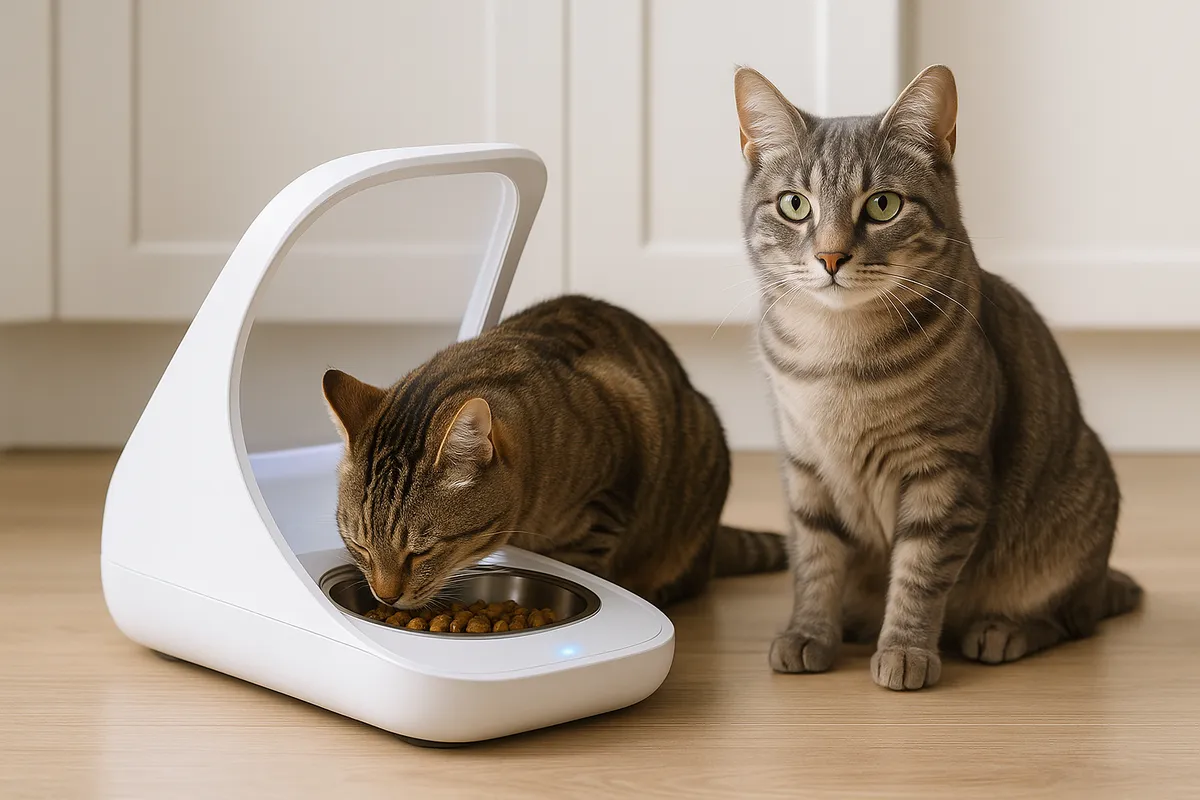
RFID Pet Feeders for Multi‑Pet Households – Benefits and Top Models
Busy urban professionals often share their homes with more than one pet. Juggling work and social commitments can make it challenging to supervise mealtimes, especially when different animals have unique diets. Traditional gravity feeders and open bowls invite food stealing, overeating and stress. Modern automatic pet feeders equipped with microchip or radio‑frequency identification (RFID) technology solve these problems by allowing only authorized pets to access the food. This guide examines how RFID feeders work, the benefits for multi‑pet households and highlights the top models on today’s market.
Understanding RFID and Microchip Pet Feeders
RFID feeders are selective feeders. Each unit contains an identification sensor (either a microchip reader or an RFID antenna) that communicates with your pet’s implanted microchip or a dedicated collar tag. When the correct pet approaches, the feeder’s lid or door opens; when other animals attempt to eat, the door remains closed or automatically shuts. This access control prevents food theft and ensures each pet receives its prescribed diet, making it ideal for households with pets of varying dietary needs and for pets on prescription diets. For example, reviewers of the SureFeed feeder noted that the feeder read each cat’s unique microchip or RFID collar tag, preventing food theft and allowing each pet to access only its own food. RFID feeders like PawsPik’s PortionPro Rx sense a pet’s collar from a distance and automatically open or close the food door depending on whether the approaching animal is authorized.
Microchip feeders function similarly but rely on your pet’s implanted identification chip instead of an active tag. They are compatible with most 9‑, 10‑ or 15‑digit microchip standards and often come with optional RFID collar tags for unchipped pets. Many feeders store dozens of pet IDs in memory so you can safely feed multiple cats or dogs from separate bowls without them stealing each other’s food.
Key Benefits for Busy Multi‑Pet Households
Prevents food stealing and mealtime stress
The primary appeal of RFID feeders is selective access. By programming the feeder to recognize each animal’s microchip or collar tag, the lid opens only for the correct pet. This eliminates “bowl raiding” behaviour, reduces fights at mealtime and ensures prescription diets are not compromised. Users of the SureFeed microchip feeder report that easy programming and automatic lid control prevented food theft and allowed designated pets to eat without interference. Similarly, PawsPik notes that its RFID feeders can sense a pet’s collar from farther away than traditional feeders and close the door when an unapproved pet approaches.
Supports weight management and special diets
Selective access allows owners to tailor portion sizes to individual pets. RFID feeders help manage weight by preventing overeating and ensuring that obese or prescription‑diet pets only receive their allotted meal. The selective feeding feature of SureFeed’s technology helps control portions and manage weight, thereby preventing food‑related health issues. In the PortionPro Rx system, unapproved pets trigger the door to close automatically, which is particularly useful when one animal needs to lose weight while another needs unrestricted access. Combining RFID access with programmable meal amounts ensures that each pet eats the proper quantity at the right times.
Maintains freshness and reduces waste
Because the lid closes tightly when the pet moves away, food stays fresher for longer. The airtight seal of the SureFeed feeder keeps wet or dry food fresh and prevents aromas from attracting other animals. Fully enclosed designs like the MiBowl prevent siblings from reaching in from the sides or back; the covered bowl can keep up to 340 g (12 oz) of wet or dry food fresh for longer. Improved freshness reduces waste and makes it safe to leave food out during long workdays.
Accommodates multiple pets easily
High‑capacity RFID feeders can store a large number of pet IDs. The Selective‑Automatic Pet Feeder from Sure Petcare holds up to 32 pet identifiers, while the MiBowl can be programmed for up to ten pets. This makes RFID feeders practical for homes with several cats and dogs. Each pet learns which bowl belongs to them, and the system does the rest. Veterinarian‑recommended models like the MPF001 are designed to be reliable and compatible with various microchip types.
Convenient and user‑friendly
Modern RFID feeders are designed for busy owners. Many models offer one‑button programming and training modes so your pet can adapt gradually to the motion of the lid. The Selective‑Automatic Pet Feeder emphasises a user‑friendly design that simplifies setup and operation. Owners report that these feeders reduce mealtime stress and are easy to clean thanks to removable, dishwasher‑safe bowls.
Cost‑effective for long‑term health
Investing in an RFID feeder may save money over time by preventing unauthorized pets from eating expensive prescription foods. Sure Petcare notes that preventing food stealing, controlling portions and keeping food fresh can reduce veterinary bills and save on special diets. Durable construction and veterinarian endorsement make them a practical long‑term solution.
What to Consider When Choosing an RFID Pet Feeder
When selecting an RFID or microchip feeder, evaluate the following factors to ensure it fits your household:
- Pet identification compatibility – Confirm that the feeder recognizes your pets’ microchip format (9‑, 10‑ or 15‑digit) or comes with RFID tags. Some models include one tag and let you purchase additional tags.
- Number of pets – Choose a feeder that can store enough pet IDs; models range from 10 to 32 pets.
- Meal scheduling and portion control – Some feeders dispense food on a schedule, while others simply provide selective access to a static dish. If you travel frequently, opt for feeders that offer programmable meal times and adjustable portion sizes. PawsPik’s PortionPro Rx allows customizable meal amounts and scheduled feedings.
- Food type and capacity – Ensure the feeder supports your pets’ diets. MiBowl and SureFeed are compatible with wet or dry foods, while others are limited to kibble. Capacity ranges from a single 1.6‑cup dish to storage hoppers holding several days of food.
- Ease of cleaning – Look for removable, dishwasher‑safe bowls and sturdy materials. MiBowl’s BPA‑free bowl can be removed and cleaned easily.
- Power and connectivity – Many feeders run on batteries, while some also offer mains power or backup batteries. Wi‑Fi‑enabled models send notifications and allow remote scheduling, though connectivity is not essential for basic RFID access.
- Noise and training features – Models with quiet motors and training modes help pets adapt without fear.
- Budget and durability – Higher‑end feeders offer more features (e.g., multi‑pet memory, robust lids, app connectivity) and may carry longer warranties. Evaluate long‑term value against initial cost.
Top RFID and Microchip Pet Feeders
SureFeed Microchip Pet Feeder (Sure Petcare)
The SureFeed Microchip Pet Feeder is widely regarded as one of the best selective feeders. It features a 1.6‑cup dish enclosed under a clear lid. The lid opens when an authorized pet’s microchip or RFID tag is detected and remains closed for others. The feeder stores up to 32 pet IDs in memory, even after battery changes, and it works with any type of food. Inside the box you’ll find a single bowl, a dual‑compartment bowl and a silicone mat for messy eaters. One‑button pairing and a multi‑stage training program make setup straightforward. Reviewers appreciate that the feeder pairs quickly with a microchip or RFID tag and includes a training mode to help timid pets acclimate.
Pros
- Selective access prevents food stealing
- Compatible with 9‑, 10‑ and 15‑digit microchips and RFID tags
- Stores up to 32 pet IDs
- Works with wet or dry food
- Simple one‑button programming and training mode
Cons
- Limited capacity; not ideal for long absences
- No built‑in scheduler; owners must measure and refill manually
MiBowl Automatic Microchip Pet Feeder (Closer Pets)
Designed for households with multiple cats or small dogs, the MiBowl offers full enclosure and compact design. It automatically detects each pet’s unique 15‑digit microchip, granting exclusive access to the food. The fully enclosed bowl prevents greedy siblings from reaching in from the rear or sides, and the compact footprint blends into home décor. MiBowl supports both wet and dry food—ideal for pets on prescription diets—and provides removable portion‑protecting clips for kittens or smaller dogs. Owners can program up to ten pets using microchips or electronic ID discs.
Key features include an easy‑to‑clean BPA‑ and phthalate‑free bowl, a covered dish that keeps up to 340 g of wet or dry food fresh, a tamper‑resistant lid with stall detection for inquisitive pets and ultra‑quiet operation. The feeder runs on four C batteries and can be used with long‑life or rechargeable cells.
Pros
- Fully enclosed design prevents unauthorized access from any angle
- Works with wet and dry foods and keeps them fresher longer
- Program up to ten pets
- Dishwasher‑safe, BPA‑free bowl
- Quiet lid and tamper‑resistant features
Cons
- Battery‑operated only; no mains power option
- Does not dispense meals on a schedule; owners measure portions manually
- The initial cost may be higher than basic automatic feeders
PortionPro Rx RFID Automatic Pet Feeder (PawsPik)
For homes with dogs and cats that like to steal each other’s kibble, the PortionPro Rx uses an active RFID collar system with “allowed” and “no‑access” tags. The feeder’s RFID antenna can sense a pet’s collar from farther away than microchip feeders and quickly opens for authorized pets while closing when an unapproved animal approaches. This mechanism, combined with customizable meal amounts and scheduled feedings, creates seamless mealtimes. In the PortionPro Rx, the pet wearing the allowed access collar triggers the door to open, while pets wearing a no‑access collar trigger it to shut.
The design includes a motorized sliding door and overlapping lid that prevents paws from getting trapped. Safety sensors detect obstacles and retract if a paw is present. The feeder allows portion control and multiple scheduled meals per day. Because the system uses active RFID tags, it can react more quickly and from a longer distance than passive microchips, making it ideal for bigger dogs that might barge in.
Pros
- Active RFID system allows rapid detection and access control
- Automatically closes door when an unauthorized pet approaches
- Customizable meal amounts and scheduled feedings
- Safety features to prevent paw injuries and jamming
Cons
- Requires pets to wear a collar tag; tags can be bulky for small cats
- Battery life of tags may be limited; no reminder system for low battery
- Pricier than basic feeders
Selective‑Automatic Pet Feeder (MPF001, Sure Petcare)
The MPF001 is a microchip and RFID compatible feeder recommended by veterinarians. It offers the ability to store up to 32 pet IDs, making it suitable for large multi‑pet households. Users appreciate its user‑friendly design and stress‑free operation. The feeder prevents food stealing, controls portions and keeps food fresh. Simple one‑button programming allows quick setup with either microchips or RFID collar tags. Because of its durable construction and three‑year warranty, it is considered a cost‑effective investment.
Pros
- Veterinarian‑recommended reliability
- Stores up to 32 pet IDs
- Compatible with various microchip types and RFID tags
- Simplified setup and stress‑free operation
- Prevents food stealing and controls portions
Cons
- Doesn’t dispense scheduled meals; purely selective access
- Higher price due to veterinarian‑grade components
Conclusion
RFID and microchip automatic pet feeders are game‑changers for busy urban pet owners and professionals. By reading each pet’s unique identifier, they prevent food theft, reduce mealtime stress and support weight management. The ability to store multiple pet IDs and maintain freshness makes them particularly valuable in multi‑pet households. Models such as the SureFeed Microchip Pet Feeder, MiBowl, PortionPro Rx and the Selective‑Automatic Pet Feeder cater to different needs—ranging from simple selective access to fully programmable feeding systems. When choosing a feeder, consider compatibility with your pets’ microchips or tags, the number of animals, meal scheduling features, food type, ease of cleaning and budget. With the right RFID feeder, you can ensure that each pet receives the right portion at the right time, giving you peace of mind and freeing up time for the moments that matter most.