Free Feeding vs. Scheduled Meals for Adult Cats: Practical Trade-Offs
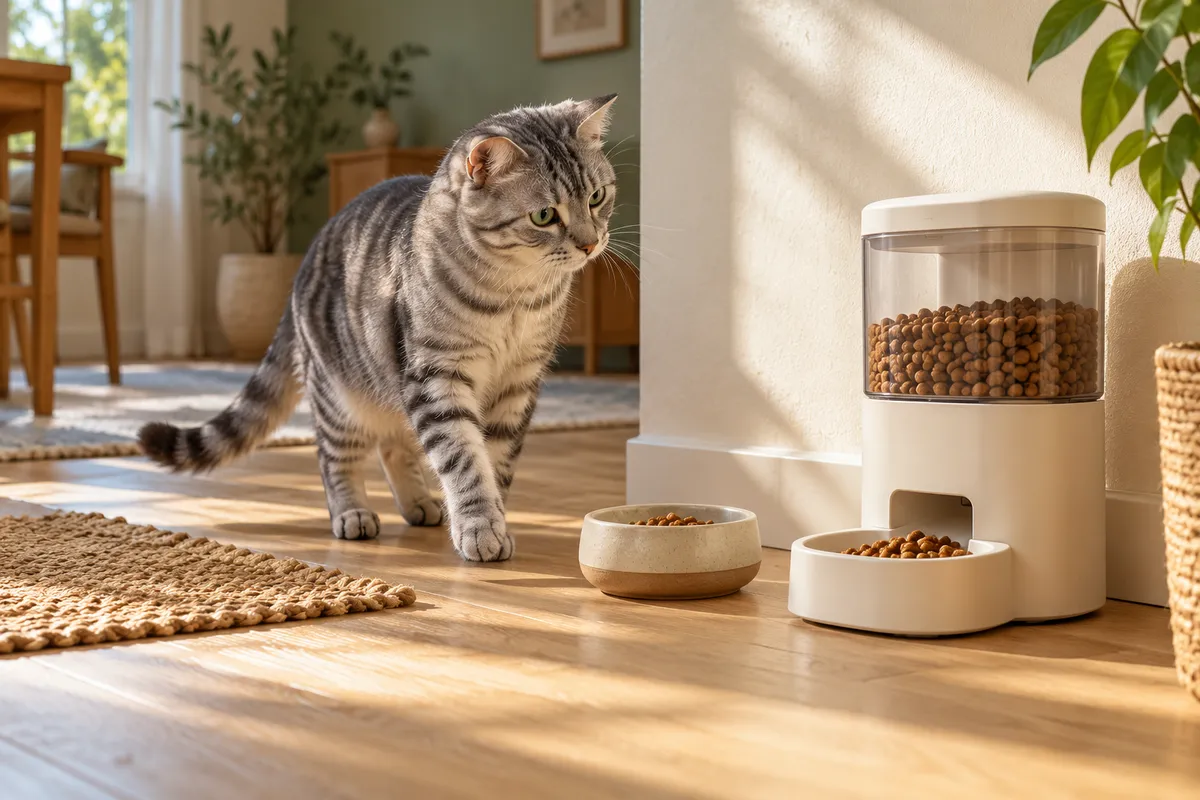
When comparing free feeding with scheduled meals, separate two questions: when is food available, and how much is offered? Food can remain available without the bowl being endlessly refilled. Equally, serving food at set times does not tell you how much your cat actually ate.
A useful comparison starts with the routine you can organize and monitor. Individual nutritional needs still matter; WSAVA’s guidance emphasizes nutrition plans tailored to the animal. (Nutrition Guidelines - WSAVA)
Three Ways to Organize Food Access
For this article, these working descriptions distinguish timing from measurement. They are not three different diets or rankings of health benefits.
| Approach | What the arrangement means | What to record |
|---|---|---|
| Unrestricted free feeding | Food remains available, with refills as needed | Every addition and the food remaining |
| Measured grazing | A measured allowance is available to eat over time | The allowance, any additions, and leftovers |
| Scheduled meals | Portions are offered at planned times | Each serving and its leftovers |
The distinction matters when describing your routine. “My cat free-feeds” could mean a bowl that is repeatedly topped up or one measured allowance that lasts across the day.
Practical Trade-Offs to Consider
Food availability versus a serving routine
With scheduled meals, decide who handles each serving and what happens when that person is unavailable. With measured grazing, decide who measures the allowance and records additions.
For example, a household could use one shared note so that the morning feeder and evening feeder can see what has already been offered. This is a bookkeeping example, not a recommended meal count or portion size.
Food served versus food eaten
VCA notes that grazing can make intake harder to assess, particularly when cats share a dish. It suggests weighing food offered, top-ups, and food remaining. (Nutrition - General Feeding Guidelines for Cats | VCA Animal Hospitals)
Whatever routine you choose, keep “offered” and “eaten” separate in your record. A serving entry alone does not account for leftovers.
| Entry | What to write down |
|---|---|
| Food offered | Food type and measured amount |
| Additions | Extra food or treats, recorded separately |
| Food remaining | Leftovers at your chosen check time |
| Household note | Who fed the cat and whether another pet had access |
This sample log is an organizational tool, not a nutritional assessment or a way to determine the correct daily allowance.
Dry food versus wet food
Food type affects the arrangement. VCA describes dry food as compatible with grazing and cautions that moist food spoils when left out for longer periods. That does not establish a universal safe time for leaving a particular product out. (Nutrition - General Feeding Guidelines for Cats | VCA Animal Hospitals)
If you offer both, list wet and dry food separately rather than treating the dry food as an unrecorded extra. Check the product’s handling instructions for storage details.
Shared bowls
In a multi-cat home, a household total may not reveal each cat’s intake. VCA identifies shared dishes as an added monitoring difficulty. (Nutrition - General Feeding Guidelines for Cats | VCA Animal Hospitals)
Ask a practical question before choosing a routine: will this setup let me tell which cat ate? A schedule on its own does not answer that question.
Questions to Ask Before Choosing a Routine
- Do you want to change food availability, the way portions are measured, or both?
- Can everyone who feeds the cat use the same record?
- Can you account for leftovers and additional food?
- Can you identify each cat’s intake if several pets share access?
- Do you need help setting the allowance before reorganizing meals?
If you are considering an automatic feeder, use the same questions when checking its instructions. Look for information about supported food, portion measurement, access by other pets, and how to inspect leftovers. This is a device-assessment checklist, not a claim that a feeder will improve health or solve a feeding problem.
Getting Help With the Feeding Plan
Choosing a routine is different from calculating nutritional needs. Ask your veterinary team to help set an appropriate allowance if that is uncertain, or if health and weight concerns affect the plan. WSAVA provides diet-history forms and body-condition resources for veterinary nutritional assessment. (Nutrition Guidelines - WSAVA)
Neither the comparison above nor the sample log establishes one best feeding method for every adult cat. Use them to describe your current setup clearly and identify what you need to measure or discuss before changing it.