Smart Pet Feeders 2025 – Market Trends Report (North America & EU)
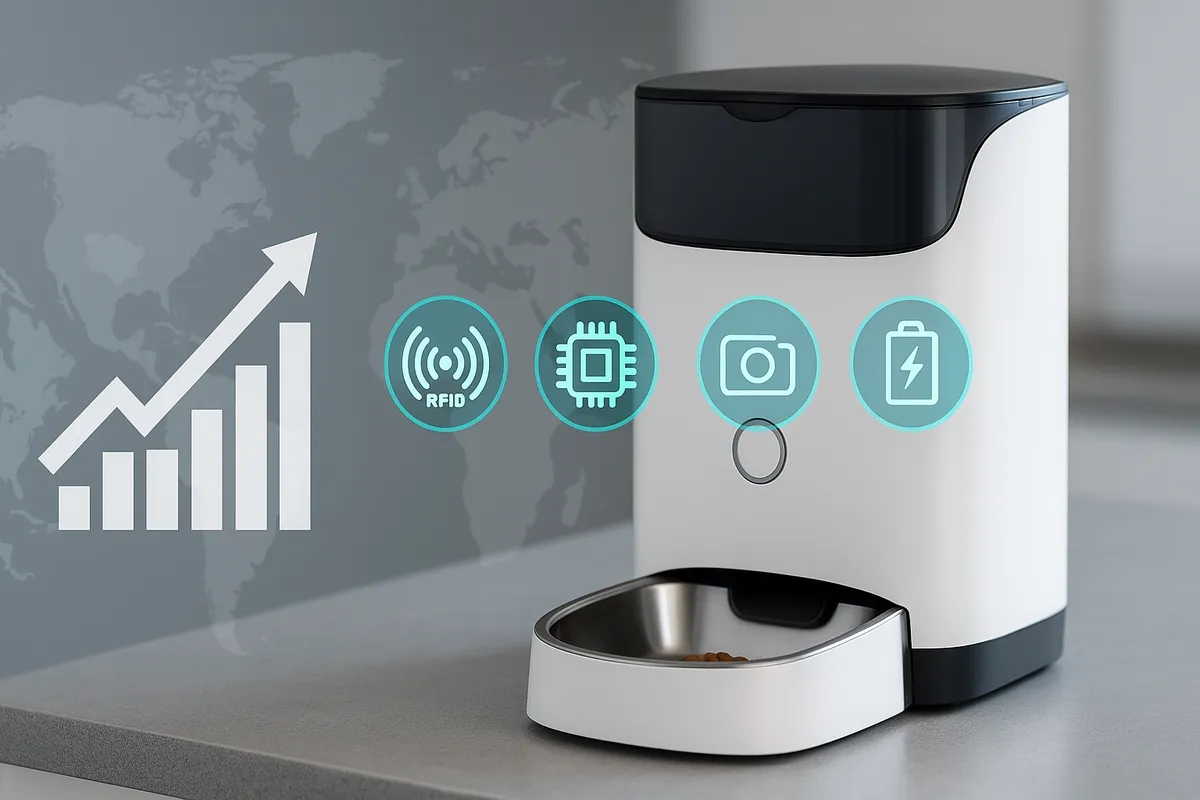
Summary: Smart feeders are moving from “nice-to-have” to “daily appliance.” In both North America and the EU, buyers value reliability, freshness, identity-aware feeding, and clear app logs over gimmicks. New launches in 2024–2025 doubled down on wet-food safety (refrigeration/rotation), encoder-verified dispensing, RFID/microchip access, and hybrid power with offline schedules.
1) Market growth at a glance (consumer view)
- Why demand is up: busier schedules, hybrid work, and rising focus on pet weight/nutrition.
- What people actually buy: feeders that don’t jam, keep food fresh, and prove (in the app) that meals were dispensed.
- Ecosystems, not widgets: feeders increasingly bundle or integrate with fountains, treat cams, scales, and ID tags under one app/subscription.
- NA vs EU common ground: both prioritize portion control and dependability; EU households lean harder into wet-food freshness and materials safety, while NA shows stronger appetite for camera/voice assistant add-ons.
Takeaway: Consumers pay for trust: sealed storage, sensor-checked portions, clear logs, and a plan for power/Wi-Fi outages.
2) Notable launches & updates (2024–2025)
Examples below illustrate trends; availability varies by region. Always verify local SKUs and safety marks.
- Petlibro Polar (wet-food refrigeration) – Thermoelectric cooling + rotating compartments to keep wet food safe for multi-day trips; sealed paths for odor and hygiene.
- Sure Petcare SureFeed (Microchip / Connect) – Microchip/RFID-gated lid stops food stealing; Connect version adds app intake logs and portion weighing—popular in EU multi-cat homes.
- PetSafe Smart Feed (latest rev.) – Reliability tweaks, better Wi-Fi/app experience, and finer portion granularity; Alexa support for hands-free top-ups.
- Vacuum-sealed hoppers (various “Space/Vacuum” lines) – Motorized or one-touch vacuum to reduce staling in humid climates; desiccant change reminders.
- Startup “all-in-ones” – Integrated scale, anti-jam auto-reverse, leftover detection, and hybrid power (DC + battery) aimed at worry-free travel and data-driven feeding.
3) Innovation radar (what’s actually new & useful)
| Theme | What it is | Why it matters |
|---|---|---|
| Freshness tech | Airtight lids, gasketed chutes, vacuum hoppers, refrigerated bowls | Keeps food palatable; crucial for wet diets and humid homes |
| Verified dispensing | Encoders + bowl weight sensors to confirm “dispensed vs delivered” | Reduces misfeeds; creates trustworthy logs |
| Identity-aware feeding | RFID/microchip gating; per-pet rules and lockout windows | Stops food stealing; supports diet segregation |
| App transparency | Event logs, CSV export, caregiver roles, privacy toggles | Easier troubleshooting; multi-caregiver households |
| Power resilience | Offline schedules, battery backup, outage alerts | Mealtimes continue without Wi-Fi or mains power |
| Smart assists | Camera clips on events, simple on-device models (bowl occupancy) | Validation without 24/7 streaming fatigue |
4) Regional differences (North America vs EU)
-
North America
- Skews toward connected extras (camera, voice assistants).
- Large online retail footprints (Amazon/Chewy) drive rapid adoption and price variety.
- Dry-kibble heavy diets make vacuum/desiccant features a crowd favorite.
-
European Union
- Strong interest in wet-food workflows (sealed, cooled, or rotating compartments).
- Emphasis on materials safety (BPA-free, stainless), quiet motors, and cleanability.
- Microchip ubiquity makes RFID/microchip feeders a natural multi-pet solution.
5) Buyer’s guide (choose by real-life needs)
A. Multi-pet homes (food stealing, prescription diets)
- Go microchip/RFID (e.g., SureFeed).
- Look for per-pet allotments and lockout windows.
- Prefer low-latency lids and anti-tailgating guards.
B. Wet-food or mixed diets
- Short trips: rotating trays with ice/gel packs and sealed lids.
- Longer coverage: refrigerated bowls/compartments (verify cleaning workflow).
- Check drip control and dishwasher-safe parts.
C. Accuracy & weight control
- Pick feeders with encoder + bowl scale; app should log scheduled vs eaten.
- Exportable logs help vets fine-tune calorie plans.
D. Freshness in humid climates
- Vacuum hoppers or at least desiccant pockets + gasketed lids.
- Smaller, more frequent refills beat overfilling giant hoppers.
E. Reliability & travel confidence
- Must-haves: offline schedules, battery backup, jam detection/auto-reverse.
- Bonus: outage and “missed dispense” alerts.
F. Smart home convenience
- Alexa/Assistant support for quick snack commands.
- Event-based camera clips (not 24/7 streams) balance visibility with privacy.
6) Quick picks by scenario (editor’s opinionated snapshot)
- Stealing-stopper for multi-cats: Microchip feeder with sealed lid + intake logging.
- Humidity hero: Vacuum-sealed hopper + desiccant reminder + gasketed chute.
- Wet-food weekender: Refrigerated/rotating feeder with tool-less cleaning path.
- Data-driven dieter: Scale-integrated model with accurate, exportable logs.
- Set-and-forget traveler: Hybrid power, offline schedules, anti-jam, outage alerts.
7) Ownership tips (to get real value)
- Calibrate portions with a kitchen scale once, then trust—but verify via logs.
- Refresh desiccants on the app’s cadence; don’t overfill hoppers.
- Introduce gradually: let pets explore the feeder powered off to reduce anxiety.
- Sanitize on schedule: bowl + chute wash cycles prevent odor and mold.
- Keep a backup bowl and small kibble stash for true emergencies.
8) FAQ (quick answers)
Do smart feeders work without Wi-Fi?
Yes—good models store schedules locally. Wi-Fi is for remote changes and notifications.
Camera or RFID—what’s more useful?
For multi-pet control, RFID/microchip wins. Cameras are best for validation and peace of mind.
Will the kibble go stale in big hoppers?
Use airtight/vacuum storage and refill more often; add desiccant and keep the unit away from heat/humidity.
9) Methodology & scope
This report focuses on consumer smart feeders for cats and small/medium dogs in North America and the EU, synthesizing 2024–2025 product lines, spec sheets, and buyer priorities we see in hands-on testing. Commercial kennel solutions and specialty veterinary dispensers are out of scope.
The bottom line
If you’re buying in 2025, prioritize freshness, verified dispensing, identity-aware access, and resilience (offline schedules + battery). Those pillars turn a neat gadget into a dependable daily appliance—one your pet (and stress levels) will thank you for.